- The problem: checkout payments with branching logic
- What goes wrong with this approach
- A “natural” improvement: inheritance
- Why inheritance still breaks down in real systems
- The strategy pattern: isolate what changes
- Implement strategies
- Compose in the context (Checkout)
- Quick comparison table
- Extending the design
- Conclusion
Goal: Replace growing
if/elseblocks with Strategy + composition so adding a new payment method doesn’t require editing existing logic.
The problem: checkout payments with branching logic
You’re building a checkout system for an e-commerce site. Users can pay with Stripe or PayPal (and later: Card, Apple Pay, UPI, etc.).
The business logic changes by payment method: fees differ, currency conversion may apply, and flows can vary.
A first attempt often looks like this:
class Checkout:
    def __init__(self, payment_method):
        self.payment_method = payment_method

    def pay(self, amount):
        if self.payment_method == "stripe":
            fee = 1.5 + 0.03 * amount
            total = amount + fee
            print(f"Stripe: Charging ${total:.2f} (including fees: ${fee:.2f})")

        elif self.payment_method == "paypal":
            usd_amount = amount * 0.012  # fake conversion rate
            fee = 0.30
            total = usd_amount + fee
            print(f"PayPal: Charging ${total:.2f} USD (converted + ${fee:.2f} fee)")

        else:
            raise ValueError("Unsupported payment method")


if __name__ == "__main__":
    Checkout("stripe").pay(100)
    Checkout("paypal").pay(100)
What goes wrong with this approach
The problem isn’t that the code “doesn’t work”—it’s that it doesn’t scale.
As soon as you add Apple Pay or UPI, the if/else block grows and becomes:
- Harder to read
- Harder to test
- Easier to break when you modify existing branches
Design smells
- High coupling:
Checkout.pay()knows too much about each gateway’s rules. - Low cohesion: one method is orchestrating + implementing multiple behaviors (SRP violation).
- OCP violation:1 every new gateway means editing
Checkout.pay().
Every new branch = modify existing code = regression risk.
A “natural” improvement: inheritance
A common refactor is to introduce a base type and one class per gateway:
from abc import ABC, abstractmethod


class PaymentProcessor(ABC):
    @abstractmethod
    def pay(self, amount: float) -> None:
        ...


class StripeProcessor(PaymentProcessor):
    def pay(self, amount: float) -> None:
        fee = 1.5 + 0.03 * amount
        total = amount + fee
        print(f"Stripe: Charging ${total:.2f} (including fees: ${fee:.2f})")


class PayPalProcessor(PaymentProcessor):
    def pay(self, amount: float) -> None:
        usd_amount = amount * 0.012
        fee = 0.30
        total = usd_amount + fee
        print(f"PayPal: Charging ${total:.2f} USD (converted + ${fee:.2f} fee)")


class Checkout:
    def __init__(self, payment_processor: PaymentProcessor):
        self.payment_processor = payment_processor

    def pay(self, amount: float) -> None:
        self.payment_processor.pay(amount)


if __name__ == "__main__":
    Checkout(StripeProcessor()).pay(100)
    Checkout(PayPalProcessor()).pay(100)
This is better: Checkout depends on an interface, not concrete implementations.
Why inheritance still breaks down in real systems
Real payment systems don’t stop at pay(amount).
They include variations like:
- Cards: network selection (Visa, Mastercard, AmEx), 3DS, SCA flows
- Fees: flat + %, tiered, region-based
- Currency conversion and taxes
- Cross-cutting logic: discounts, fraud checks, promotions
If you try to model all of that in one base class, it becomes a “fat interface”:
from abc import ABC, abstractmethod


class PaymentProcessor(ABC):
    @abstractmethod
    def pay(self, amount: float) -> None:
        ...

    @abstractmethod
    def authorise(self, amount: float) -> None:
        ...

    @abstractmethod
    def calc_fee(self, amount: float) -> float:
        ...

    @abstractmethod
    def convert_currency(self, amount: float) -> float:
        ...

    @abstractmethod
    def apply_discount(self, amount: float) -> float:
        ...

    @abstractmethod
    def choose_network(self) -> str:
        ...
Now you get:
- ISP violation: subclasses are forced to implement methods they don’t need.
- Subclass explosion: every combo becomes a class.
- Back to OCP risk: base class keeps changing.
A Stripe processor shouldn’t have to “choose a card network”—but this design forces it.
ISP (Interface Segregation Principle):2 clients should not be forced to depend on methods they do not use.
The strategy pattern: isolate what changes
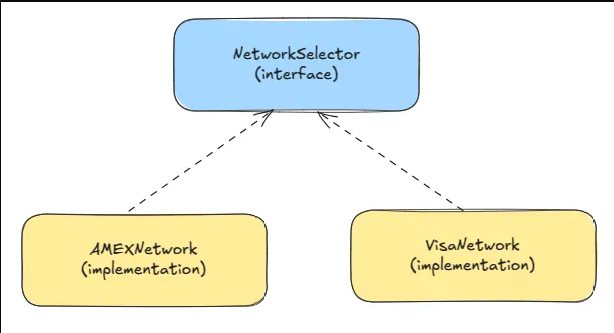
Step 1: Identify stable vs. changing parts
In our payment example:
- Stable (Context): the checkout flow (orchestration)
- Changing (Strategies): fee calculation, network selection, currency conversion, etc.
Step 2: Create small interfaces for the varying parts
Keep interfaces small and focused:
from abc import ABC, abstractmethod


class PaymentProcessor(ABC):
    @abstractmethod
    def pay(self, amount: float) -> None:
        ...


class NetworkSelector(ABC):
    @abstractmethod
    def choose_network(self) -> str:
        ...
Why “program to an interface” matters3
Bad (calling concrete methods):
network_selector = VisaNetwork()
network_selector.choose_visa()

network_selector = AmexNetwork()
network_selector.choose_amex()
Good (calling a shared contract):
network_selector = VisaSelector()
network_selector.choose_network()

network_selector = AmexSelector()
network_selector.choose_network()
Implement strategies
Concrete strategies do one job well:
# Network selection strategies
class VisaSelector(NetworkSelector):
    def choose_network(self) -> str:
        return "Visa"


class AmexSelector(NetworkSelector):
    def choose_network(self) -> str:
        return "Amex"


class NoNetwork(NetworkSelector):
    def choose_network(self) -> str:
        return "N/A"


# Payment strategies
class StripeProcessor(PaymentProcessor):
    def pay(self, amount: float) -> None:
        fee = 1.5 + 0.03 * amount
        print(f"Stripe: Charging ${amount + fee:.2f}")


class PayPalProcessor(PaymentProcessor):
    def pay(self, amount: float) -> None:
        usd_amount = amount * 0.012
        fee = 0.30
        print(f"PayPal: Charging ${usd_amount + fee:.2f} USD")


class CardProcessor(PaymentProcessor):
    def __init__(self, network_selector: NetworkSelector):
        self.network_selector = network_selector

    def pay(self, amount: float) -> None:
        net = self.network_selector.choose_network()
        print(f"{net} card: charging ${amount:.2f}")
Compose in the context (Checkout)
Checkout is the Context. It delegates work to the currently selected strategy.
from typing import Optional


class Checkout:
    def __init__(self, payment_strategy: Optional[PaymentProcessor] = None):
        self._payment_strategy: Optional[PaymentProcessor] = None
        if payment_strategy is not None:
            self.payment_strategy = payment_strategy

    @property
    def payment_strategy(self) -> PaymentProcessor:
        if self._payment_strategy is None:
            raise ValueError("Payment strategy not set.")
        return self._payment_strategy

    @payment_strategy.setter
    def payment_strategy(self, strategy: PaymentProcessor) -> None:
        if not isinstance(strategy, PaymentProcessor):
            raise TypeError("payment_strategy must implement PaymentProcessor.")
        self._payment_strategy = strategy

    def pay(self, amount: float) -> None:
        self.payment_strategy.pay(amount)
Now strategy switching becomes a runtime decision:
checkout = Checkout()

checkout.payment_strategy = StripeProcessor()
checkout.pay(100)

checkout.payment_strategy = CardProcessor(VisaSelector())
checkout.pay(50)
Use constructor injection when the strategy is required and stable. Allow swapping only if your domain needs it (e.g., “user changes payment method before checkout submit”).
Quick comparison table
| Approach | Pros | Cons | Best for |
|---|---|---|---|
if/else dispatch | Simple to start | Grows messy, OCP breaks | Tiny scripts, 2–3 stable cases |
| Inheritance-only | Polymorphism, cleaner Checkout | Fat base class, subclass explosion | When variations are few & aligned |
| Strategy + composition | Extensible, testable, OCP-friendly | More classes/objects | Real systems with evolving behaviors |
Extending the design
Want discounts, taxes, fraud checks?
Add more small interfaces and compose them:
DiscountPolicy.apply(amount) -> amountFeePolicy.fee(amount) -> feeCurrencyConverter.convert(amount) -> amountFraudCheck.verify(order) -> bool
Each concern stays isolated, and you can mix-and-match.
Conclusion
When to use Strategy
Use it when you have multiple behaviors that:
- do the same job with different internal logic
- need to change independently over time
- should be selectable at runtime (user choice, region, config)
- are starting to create large
if/elseblocks
When not to use Strategy
Skip it if:
- you have one behavior and it’s unlikely to change
- the abstraction adds more complexity than value
Notes
-
Robert C. Martin, Agile Software Development: Principles, Patterns, and Practices (Prentice Hall, 2002). ↩
-
Interface Segregation Principle (ISP): keep interfaces small so implementers don’t inherit methods they don’t need. ↩
-
Erich Gamma, Richard Helm, Ralph Johnson, and John Vlissides, Design Patterns: Elements of Reusable Object-Oriented Software (Addison-Wesley, 1994) ↩