- 1. Argument from Consequences
- 2. Straw Man
- 3. Appeal to Irrelevant Authority
- 4. Equivocation
- 5. False Dilemma
- 6. Not a Cause for a Cause
- 7. Appeal to Fear
- 8. Hasty Generalization
- 9. Appeal to Ignorance
- 10. No True Scotsman
This book genuinely changed how I think about many everyday arguments. The examples feel surprisingly familiar- they’re the kinds of claims I’ve actually heard in real life. So if an example appears here, chances are I’ve encountered it myself. No offense intended to anyone; in hindsight, many of these moments are simply funny and human.
1. Argument from Consequences
Just because the consequence of a claim / statement is good or bad - does not tell us the truth about the claim itself. Discussions should focus on the truth of the claim itself, not on whether we like its outcomes.
- That person exercised every day, yet they died of a heart attack. Therefore, no need to exercise.
Arguments like this are faulty because they try to support or deny a statement’s truth based solely on its consequences.
When consequences are good, it plays to one’s hopes; and when they are bad, they play to one’s fears.
PS: I guess it plays to the desire of not doing any exercise
2. Straw Man
A straw man occurs when someone purposefully misrepresents, oversimplifies, misquotes, misconstrues an opponent’s position, to make it easier to attack them.
In other words, they attack a stick figure instead of the real person.
Misrepresenting the idea is much easier than refuting the evidence for it
If you are in this situation, do not ever defend the distorted version of your argument - instead restate your actual position.
3. Appeal to Irrelevant Authority
The idea is that an argument is more likely to be fallacious when the appeal of it is made to an irrelavant authority, one who is not an expert on the subject. Basically appealing to someone vague / unknown.
- A client told me that babies are now being grown entirely in boxes and women are no longer needed. It is true- her son lives in Germany. 1
Or attributed to a faceless collective.
4. Equivocation
Exploiting the ambiguity of a language by changing the meaning of a word during the course of an argument and using the different meanings to support an ill-founded conclusion.
How can you be against faith when you take leaps of faith all the time: making investments, trusting friends, and even getting engaged? 2
This fallacy occurs mostly in discussions of science and religion.
5. False Dilemma
A false dilemma is when a person is presented with a limited set of two options as if those are the only possibilities, forcing a choice between them while ignoring other alternatives.
- If you’re not studying all the time, then you have no future.
- If I dont become a doctor or an engineer, I’m just a failure.
These 2 examples could also be an example of false dilemma, if you think these are the only valid dilemmas one can face. #foodforthought
IRL, we have more than 2 valid choices.
6. Not a Cause for a Cause
This fallacy occurs when 2 events happen one after another and we assume that one caused the other without sufficient evidence. The events may simply be coincidental or influenced by another factor.
- I wore my lucky shirt and we won the match. The shirt must be lucky.
- I can’t say that, because in 1976 I did a drawing of a robot and then Star Wars came out, they must have copied the idea from me. 2
Some of you may know this idea as: correlation ≠ causation.3 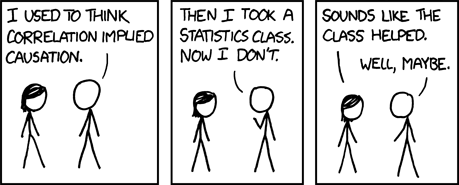
7. Appeal to Fear
This fallacy manipulates an audience by invoking fear, imagining a frightening future that would occur if a certain proposition were true. Instead of providing solid evidence, it relies on rhetoric, threats, or deception to push people toward a conclusion.
- A scammer calls and tells me to share my OTP (one time password) or else I could lose a brand new Skoda 4
Rather than presenting evidence, the argument pressures the listener into acting out of fear.
One way to detect the fallacy is to notice that the person who is making such claims mainly relies on worst-case scenarios instead of evidence or a balanced approach, often presenting only one conclusion that is based on fear.
Animal Farm also illustrates this tactic through propaganda and fear-based control. You can read my thoughts on it here
8. Hasty Generalization
This fallacy occurs when one forms a conclusion from a sample size which is too small or too special to be representative.
- One engineering graduate I hired couldn’t code properly. Engineering colleges don’t teach anything useful.
A few personal experiences are treated as enough evidence to judge an entire group. 5
9. Appeal to Ignorance
This fallacy occurs when a proposition is claimed to be true because it has not been proven false, or false because it has not been proven true. In other words, a lack of evidence is incorrectly treated as evidence itself.
- Ayurveda and other alternative sciences should be preserved whether you believe in them or not. Current medical science is in no condition to call them pseudosciences.
The statement implies:
- Medicine must first prove alternative systems wrong before criticizing them.
The argument treats the absence of disproof as support for legitimacy.
The fact is that the “burden of proof” always lies with the person making a claim, not with others to disprove it.
A good response is to ask whether there is something from the past observations which could likely support such a claim.
A related form of this fallacy is personal incredulity, where one assumes something must not be true, because one cannot imagine it to be true..
- No one has proven that this stock-market ‘guru’ is fake, so his advice must be genuine- better to buy his course
10. No True Scotsman
The fallacy happens when someone makes a blanket statement about a group, and when they are presented with counter evidences- challenging their claims. Instead of admitting they are wrong or contesting the evidence- they dodge it by redefining the criteria to be a member of that group.
“Most doctors are only after money.”
When shown examples of doctors who earn modestly and work long, demanding hours, the response becomes:
“Well, no real doctors are like that- I meant doctors from the newer generation.”
Instead of reconsidering the claim, they shift the definition to protect it.
-
True story bro ↩
-
Many scams exploit fear, urgency, greed, or panic. You are digitally arrested. ↩
-
Larger, representative samples are required before making general claims. See: Hasty generalization. ↩